Employer Statement
The Teaching Council is committed to fairness, transparency and equality in all aspects of employment. As the statutory regulator of the teaching profession, we recognise the importance of maintaining an inclusive and equitable workplace. The gender pay gap reporting process provides a valuable opportunity to reflect on our workforce structure and ensure our policies and practices continue to support equality.
The gender pay gap is not a measure of equal pay for equal work. Instead, it reflects the distribution of men and women across the organisation and the roles they hold. The Teaching Council’s gender pay gap results are influenced primarily by the composition of our workforce, which is predominantly female and reflects patterns seen more widely in the education sector and across public service administrative and regulatory bodies.
As of 30th June 2025, the Teaching Council employed 72 staff members. Of these, 63 were full-time and 9 were part-time. Women represent 83% of the overall workforce, while men represent 17%. Among full-time employees, 81% are women and 19% are men. All part-time roles at the snapshot date were held by women, which is consistent with national trends in flexible and part-time working.
This workforce profile directly shapes our gender pay gap metrics. For full-time employees, the mean gender pay gap is -1%, meaning that women’s average pay is slightly higher than men’s. The median gender pay gap is 3%. These small differences reflect the distribution of men and women across grades rather than any disparity in pay for comparable work.
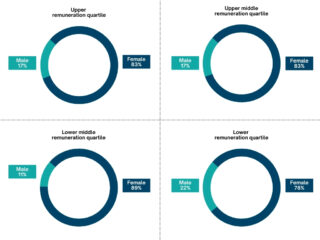
A similar pattern appears across remuneration quartiles. Women make up 83% of employees in both the upper and upper-middle quartiles, 89% in the lower-middle quartile and 78% in the lower quartile. This demonstrates strong female representation across all levels of the organisation, including specialist and senior roles, and confirms that the gender pay gap is primarily the result of workforce composition rather than unequal pay.
All Teaching Council employees are paid according to published civil service pay scales, which apply equally to men and women. Recruitment and promotion processes follow established public-sector procedures and are designed to be open, transparent and merit-based. This ensures that men and women performing the same roles are paid on the same basis and progress through grades in the same way.
The difference in working patterns also contributes to the figures, as all part-time roles are currently held by women. While part-time work can affect some elements of the gender pay gap calculations, these roles are paid according to the same structured scales as full-time positions. The Teaching Council continues to support flexible working arrangements and takes care to ensure that such arrangements do not limit access to development opportunities or career progression.
Looking ahead, the Teaching Council will continue to monitor gender representation across grades and working patterns and will use future reporting cycles to identify any emerging trends. We will maintain our commitment to fair and transparent recruitment and promotion practices and support professional development opportunities that are accessible to all staff.
The Teaching Council values the contribution of every employee and remains committed to sustaining a workplace culture based on fairness, respect and inclusion. Our gender pay gap results reflect a predominantly female workforce operating within a clear and consistent pay structure, and we will continue to ensure that equality remains central to how we support and develop our staff.
Snapshot date: 30 June 2025
| Headcount 30 June 2025 | Full time employees | Part time employees | Total |
|---|---|---|---|
| Male | 12 | 0 | 12 |
| Female | 51 | 9 | 60 |
| Total | 63 | 9 | 72 |
| Gender breakdown | Male | Female |
|---|---|---|
| Overall | 17% | 83% |
| Part time employees | 0% | 100% |
| Full time employees | 19% | 81% |
| Gender Pay Gap Metrics | Mean | Median |
|---|---|---|
| Full time employees | -1% | 3% |
Quartiles